Artist Information HMS Victory Sculpture Upcycled sculptures Wood/Bronze Sculptures HMS Victory
Journal / Bio
Garter
Knights Crests Bath Knights Crests
Creating a Crest/Arms Short
TV Films Home

Artist Information HMS Victory Sculpture Upcycled sculptures Wood/Bronze Sculptures HMS Victory
Journal / Bio
Garter
Knights Crests Bath Knights Crests
Creating a Crest/Arms Short
TV Films Home
This scale model of Lord Nelson’s Flagship HMS Victory has been carved entirely from centuries old oak timbers removed from HMS Victory during the ships restoration program over 25 years ago. The model was then placed on display within Chatham historic dockyards in Kent where HMS Victory was built 250 years ago. Every part of this replica including the hull, sails, ropes and rigging which have all been individually carved from solid pieces of original beams from the very ship it replicates including the carved signal flags displaying Admiral Nelson’s famous signal ‘England expects every man to do his duty’.
Page
Section
under construction –
The HMS Victory sculpture
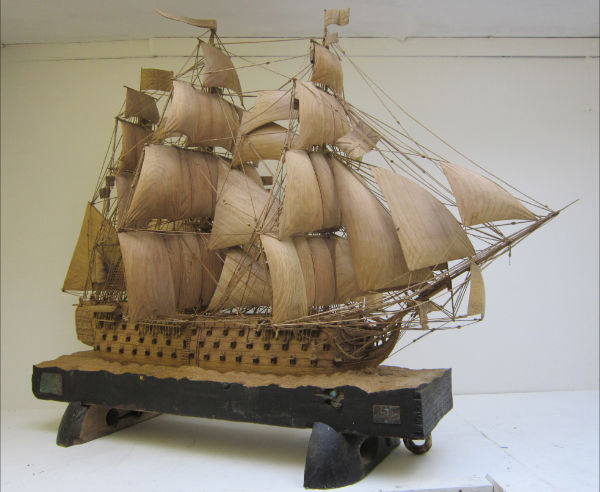
'Running before the Wind'
'Running before the Wind' – carved from HMS Victory oak - 47 inches long
This large scale replica of HMS Victory has been carved in full sail ‘Running before the Wind’, aided with the guidance from HMS Victory’s former curator for twenty years Peter Goodwin who kindly provided technical advice during its creation. The carving process alone has taken Ian over eighteen years on and off to complete, working on it alongside his sculpture commissions and although it may look rather fragile being carved entirely from old oak timbers it is rather strong and has survive often bumpy road journeys to prestigious exhibitions venues in both the City of London and Chatham’s Historic Dockyard in Kent where in 1765 HMS Victory was built.
The Victory models hull and the ‘sea’ the warship is sailing in, was once hidden away deep within a large old beam which was once placed in the deckhead between a pair of 32 pounder guns (cannons) on the lower gun deck of HMS Victory and twenty five years later the then completed model once again found itself placed between two massive guns of the same period in Chatham's Historic Dockyard, a mere musket shot away from the very spot where HMS Victory was first launched in 1765. It had been said this HMS Victory replica made from the ships own timbers and once part of the very oak structure of Lord Nelson’s famous Flagship, was the closest thing to once again having HMS Victory back at Chatham dockyard.
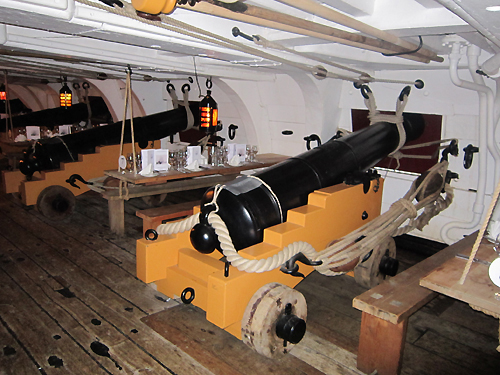
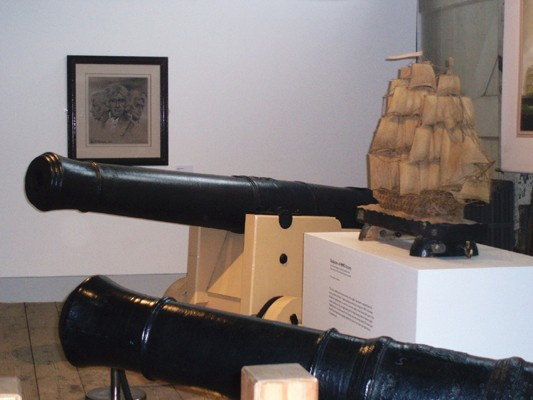
When the Victory sculpture was placed on display in 2015, during the 250th anniversary celebrations of the launch of HMS Victory, some of the finest exhibits in the World featuring Admiral Lord Nelson and HMS Victory were also on display in Chatham Historic Dockyard. These particular historic exhibits were on loan from such establishments as the National Maritime Museum in London; which is the world's largest maritime museum who had amongst other things provided for the exhibition a stunning decorative sword along with original letters and plans. The National Museum of the Royal Navy in Portsmouth the now home of Nelson’s Flagship had provided HMS Victory’s figurehead and from the Royal Collection on loan by Her Majesty The Queen was the actual lead musket ball which dealt the fatal blow to Lord Nelson on October 21st 1805 at the Battle of Trafalgar, mounted with some remnants of the gold lace from Admiral Nelson's uniform and when this ‘HMS Victory; the untold story exhibition’ was over months later all the exhibits were then returned to their respective owners. Shortly afterwards the gallery where the Victory sculpture had been on display for over two years was about to close as major refurbishment to the gallery were about to start so Ian collected the model and was returned back to his studio and then placed inside its newly completed sculpted solid mahogany cabinet he had built from timbers he rescued a decade ago from a neighbours skip.
In October 2025 the Victory Sculpture was placed on display in The Staithes Art
Gallery wells next the sea in Norfolk, a mere cannon shot from where Admiral Lord Nelson was born.
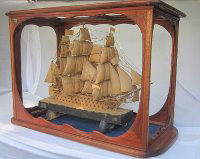

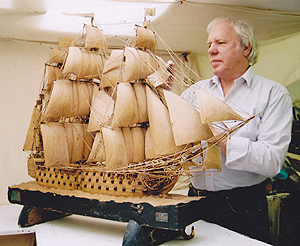
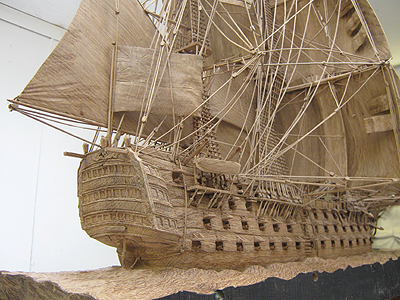
The Victory sculpture - approximately 47 inches (120cm) x 19 inches ( 48 cm) wide x 36 " (92cm) high
(excluding the mahogany display cabinet)
The process of creating a scale replica of HMS Victory a ‘First Rate Ship of the Line’ carved in full sail ‘Running before the wind’ entirely from centuries old Victory’s oak timbers and nothing else.
"This page outlines how the ‘Victory sculpture’ was carved during the various different stages and although I would be the first to admit I am not an expert on making ship models, in fact this was my first and will most certainly be my last, so this page is not meant to be an abject lesson on how to produce a model ship and is most certainly not the traditional way of making such a thing, but it will hopefully explain how I made this one.
Normally when I include a ‘how it was made’ section on my website I tend not to get to preoccupied with the condition of the timber being used for the particular carving project as if the timber was not of the finest quality in the first place, I simply wouldn’t waste anyone’s time especially my own trying to create anything worthwhile from it. The biggest challenge I found creating the replica of HMS Victory was without doubt trying to eke out every tiny piece of Victory oak that was of a good enough quality to carve from amongst the pile of old once discarded ships beams that clearly wasn’t and if the pieces of oak, I was kindly given was eventually found not to be in good enough condition to be used, it simply wasn’t used.
Finding suitable good quality pieces of original oak from within HMS Victory’s original ships timbers due their initial poor condition often felt at times on a par to panning for gold, as this model was created entirely from sound pieces of Victory oak searched out for from deep within a pile of old often misshaped, rotten; worm damaged beams removed from the ships wooden hull which was known at times to also contain assorted pieces of metal in which it has been said, some of the metal was forced into the oak by the British at Chatham and some by the French at Trafalgar.
As far as carving Victory oak is concerned; PC aside, this is where a bit of ageism comes in to it, as from day one for all the various Victory oak carving projects I was involved with we were only real interest in using oak that was once ideally part of the very structure of the ship when she was built in 1765, or if not during the early part of the 19th century and more particularly to be oak that was once part of the hull of HMS Victory during the Battle of Trafalgar, otherwise what was the point in all the hassle and oh so many long hours trying to carve anything worthwhile from them, although often as a consequence such timbers being the oldest were most likely found to be in the worst condition.
The fact is although it may well have taken me quite a while to grasp, the most important quality you require if you find yourself with a piece of really old ships timbers to work with is to be a real optimist! The reason I started to carve the Victory replica in the first place entirely from her own oak timbers and nothing else, was that it gave me a rather unique opportunity of being able to create a large three-dimensional scale sculpture of HMS Victory carved in full sail, in a way that has never been done before and due to the unlikelihood today of obtaining suitable larger pieces of centuries old Victory oak, will ever be made quite like it again, even with the new-fangled 3D printers!
So for those not really interested in how the Victory sculpture was created carved entirely from HMS Victory's own timbers and nothing else and more particularly all the trials and tribulations over the two decades in my attempting to do just that, which is what these particular pages are all about; then please look away now.

.jpg)
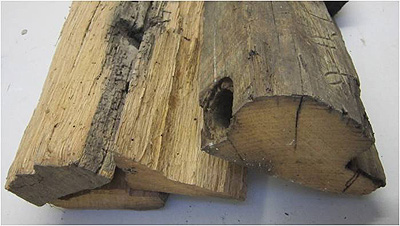
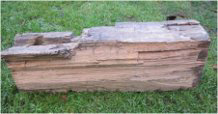
The Victory Sculpture in kit form
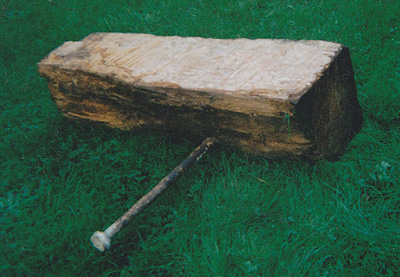
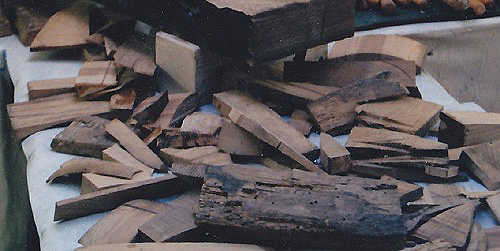
The various pieces of Victory oak basically used to create the model of HMS Victory in full sail. The first photo shows the remains of the oak beam which was mainly used to carve the hull along with the sea the warship was sailing in. The second shows the oak beam used to carve most of the main sails. The third shows some of the off cuts used to carve amongst other small objects including the boats, guns, spars, anchors etc. The fourth and fifth photograph shows the original state of the oak beam used to carve the models ‘stay’ sails. The sixth photograph shows an often-typical piece of Victory oak which was found to be stained black over the years caused by a corroding centuries old iron nail found hidden away inside the oak beam you would more often than not encounter cutting though one of these old ships beams. On this occasion also hidden away was a long brass screw which was fortunately narrowly missed by the chainsaw and twenty years or so later, this piece of oak was set into the frame work of the mahogany cabinet now displaying the model along with one of the ships small carved 32 pounder guns now placed into the oak.
It has to be said this old Victory oak is not a particularly pleasant timber to carve especially in the condition it was often found to be in, but the simple fact is if it wasn’t for the history and provenance of these centuries old ship timbers I wouldn’t have bothered working with them in the first place, however carving Victory oak was always going to be a very different prospect right from the start and out of all the projects I have completed during the past thirty years this model of HMS Victory took the longest to carve by far. However, despite the inherent difficulties working with such old ships timbers that had initially clearly seen better days; it has only ever been about the timbers themselves that really mattered. If it was going to be all about the finished carvings, I would have carved them all from the best timber available like I normally do with my other wood sculptures. However, despite the relative problems carving it I am fully aware if the oak didn’t have any of the aforementioned peculiarities and they were in a good condition the simple fact is they wouldn’t have been removed from the ship’s hull in the first place.
Despite oak being the ‘National tree of England’ given the preference I prefer not to carve oak unless it is specifically requested by the client, which as it happens appears to be more often than not. There are many examples of my oak woodcarvings around, such as the carved oak Pascal candle stand commissioned for St George’s Chapel in Windsor Castle along with a bas-relief carving of a Knights Coat of Arms commissioned to be placed within the crypt in St Paul’s Cathedral, just a few feet from where Lord Nelson’s tomb can be found today.
Oak is classified as a hardwood which is a term used to describe the timbers qualities and suitability for any particular job, but early Victory oak due to it being so well seasoned over the centuries within the hull of Nelson’s Flagship, is as far as a the term hardwood is concerned is in a league all of its own and often felt like trying to carve concrete. So despite my preference for carving any hard timber apart from oak it is quite ironic that I then end up spending almost twenty years carving one of the oldest and hardest pieces of oak available; HMS Victory oak".
It has been said amongst my family, many of which have served in the Royal Marines, including my father James Brennan that one of our distant ancestors was a Royal Marine John Brennan who came from Shannon in the Irish republic and fought and died alongside Admiral Nelson on-board HMS Victory during the Battle of Trafalgar. Although I am English, my father was Scottish but our early ancestors on my father’s side came from the Irish republic.
The history and the various stages behind producing the carving of HMS Victory :-
This page is not really about how you make a model of HMS Victory or how long it took even though both subjects are well covered here, but it is so much more about the actual unique ships timbers themselves and what it takes to transform these once discarded tired old Victory oak beams into a somewhat smaller version of itself which I tend to concentrate on most. It is said that around 20% of HMS Victory in Portsmouth Historic Naval Dockyard contains timbers used during the ships construction in 1765 which can mostly be found on the lower gun deck area and below.
Much of the timbers removed from the ship during the restoration program were being removed and replaced through normal wear and tear generally expected of a wooden warship of that period. During the later years whenever possible some of these old timbers were skilfully reworked and replaced back on the ship in some form or another, however despite the shipwrights best efforts this was not really practical, realistic or indeed cost effective thing to do so. Eventually the fate of such ships timbers during the past two and a half centuries have amongst many other things, simply rotted away, been eaten by woodworm or been removed during updating or through damage the ship frequently received during battle. In truth HMS Victory like all such warships of that period being made entirely from wood, were only expected to be serviceable for around 40 years, or possibly just to the next battle and were simply not designed to last forever.
During the past 250 years HMS Victory had to endure many things, hostile action including by the French who gave her a massive pounding at Trafalgar when she was locked together with the ship Redoubtable only feet apart for almost an hour in which both ships exchanged fearsome broadsides, in arguably the greatest Naval triumph the world has ever seen. The massive pounding the ship has also endured by the sea, weather and human neglect over the centuries along with her massive oak timbers being constantly eaten by death watch beetles and the worm corynetes coeruleus and if that doesn’t sound frightful enough, the Luftwaffe almost blew her up when a high explosive devise blew a 15 ft wide hole in her hull during an air raid over Portsmouth Naval Docks in 1941. Although most likely not in the forefront of the pilots mind when he dropped the bomb as it turned out the gaping hole which was then left in HMS Victory’s hull courtesy of the Luftwaffe actually aided the preservation of this mighty wooden warship by helping to ventilate the gun decks.
In preparation for the bicentenary celebrations in 2005, HMS Victory underwent a major refit and during 1991/1992, Ian G Brennan was commissioned by The Royal Naval Dockyard in Portsmouth to carve from mahogany an exact replica of the original starboard side entrance port on Admiral Lord Nelson's Flagship, HMS Victory, to replace most of the original carved painted and gilded oak entrance port which was so badly decayed it was beyond restoration. In many places, it was only the thick layers of old black lead paint that was keeping most of the original oak entrance port together.

The replacement starboard side entrance port carved by Ian G Brennan during 1991/1992
Ian was shown onboard to see how the current restoration work was progressing. It was clear to see the centuries had taken their toll on some of the other oak timbers on the Victory particularly those on the lower gun deck. Some of the original oak beams were found to be very badly rotten and worm damaged and were subsequently removed and replaced with timbers skilfully by the shipwrights in Portsmouth Naval Dockyard mostly from teak and iroco.
This much needed restoration, which has now gone on for many decades, was being concentrated on the starboard side, lower gun deck area around the seventh gun port. Some of these original oak beams were being carefully removed from where the 32 pounder was normally positioned. The vast majority of the lower gun deck is said to be the original oak timber used in the construction of HMS Victory in 1765 and by examining the condition of the oak beams this could easily be the case. Some of the old oak beams simply crumbled away in your hands due to worm damage and decay, hence the reason they were being removed from the ship.
Most of the beams were being removed by shipwrights using chainsaws and although attempts were made to keep the old oak beams as large as possible which would enable the beams if found to be in restorable, could then be returned, back onto the ship. However as these beams were often very difficult to access in such cramped conditions on the lower gun deck, many could only be removed in smaller sections. Once removed if the beams were found to be un-restorable were then rather unceremoniously thrown through the large gaping hole in the ships starboard side down into the waiting skips below.
There were however two large thick oak beams that were roughly four feet long which were eventually removed relatively intact from the ceiling, although they like other beams were suffering badly from rot and worm damage. On close inspection it was found that these to were, unfortunately, unsuitable for restoration and were like the others simply dropped down into the waiting skips below on the dockside alongside the Victory.
All the beams that were removed which could not be fully restored were subsequently later replaced by similar shaped beams skilfully recreated by the ship wrights, in the workshops inside number 4 boat house near to HMS Victory. Large blocks of Iroco timber were mostly used as Iroco has proved to be much more durable in the conditions within the warship than large pieces of oak have proved to be in the past. These old beams were later placed into the basement of the old Georgian building which once stood alongside HMS Victory, later demolished to make way for the new Mary Rose museum; to join the pile of old ships timbers and assorted pieces of copper and iron and over twenty years ago the remains of which were sold off to help towards funding Victory’s ongoing restoration for the upcoming bicentenary celebrations.
Most of the oak beams were firmly attached to the deck head (ceiling) of the lower gun deck by large iron and copper bolts which had to be first cut through to enable the beams to be removed. One of these beams, which were used to create the Victory sculpture, still had the original iron hook embedded into its base which once held the rope attached to the crews mess table which was original fixed into the deck head above 32-pounder gun. When called to action stations the ropes holding the mess tables were quickly removed from these hooks allowing mess tables to be quickly stored away below. Another large oak beam removed from the same area of the lower gun deck was later used to carve the ‘Breaking the Allied line’ and was eventually placed onboard on HMS Victory’s middle gun deck.


The 32-pounder gun, hammock and mess table on the lower gun deck on HMS Victory – close up showing the original iron hook supporting the mess table fixed into the deck head.
Ian was later asked, as many of these old oak beams were obviously not in any condition to be restored and returned to the ship, if he would like to try and see if it were possible to carve anything useful from what might possibly be salvaged from them rather than the oak being simply wasted. It was suggested that in return for being given these old Victory oak beams perhaps he could try and carve one or two relief carvings from pieces of them which he could then donate to some of the charities supported within Portsmouth Dockyard; something Ian was more than happy to do.


Two of the Victory relief panels donated for the charity fundraising
As HMS Victory’s crew were also often raising funds for various charities, including the annual BBC’s Children in Need appeal; one of the first of these larger carvings Ian produced from Victory oak was a bas-relief carving of HMS Victory shown from the bow. This relief carving was then auction off within the Naval Dockyard for the BBC’s ‘Children in Need' appeal which fortunately raised a lot of money for the charity. He was then asked to carve and donate another similar size panel of the Victory for the following years fund raising event, this particular bas-relief carving depicted HMS Victory from the Stern.
When Ian was given some of these original Victory timbers they were often covered in thick layers of old lead paint and frequently contained either holes where iron or copper bolts were once attached or as often or not the remains of these old iron and copper bolts still firmly embedded in position deep within the beams. As these iron bolts had often badly corroded over the centuries in made then very difficult to remove without having to cut away the oak that surrounded them.
Apart from the bas-relief carved relief panels of ‘HMS Victory in full sail’ Ian has donated over the years, he has also carved several other smaller items again all from pieces of these original HMS Victory timbers. Not only were they given to a wide variety of charities to auction off to make some funds for their particular worthy causes, but he also produced some other smaller carvings which were then often presented to retiring crew members and the occasional visiting VIPs to Portsmouth Dockyard.


These carvings created from these Victory’s timbers have also included such objects as a small Victory topsail, replicas of 32 pounder guns and a typical wooden spoon and goblet
One of the most popular smaller carvings he was asked to produce for the various charities etc was a model of a 32 pounder gun and on one occasion Ian was also asked if it would be possible to carve one of his 8 inches long 32 pounder guns this time from part of what remained of one of HMS Victory’s original large deadeyes which were originally used to restrain and to put tension on the Victory’s various standing rigging lines. Most of this particular deadeye was missing and what remained was badly split and deemed beyond practical restoration and was being now being replaced.
Although it was often the case that although on the outside of the these old Victory timbers as they were often covered in paint often still with old metal protruding from them they initially appear to be in quite a reasonable condition, more often the case the moment Ian got them back to the workshop and the layers of old paint removed, the splits, rot and worm damage was found to be much more extensive than first hoped, great lumps of oak, much of which had the texture of soft cork would simply crumbled away in his hands and in the end nothing useful could be done with them.
The two large oak beams that were removed from the deck head the lower gun deck showed a little more promise however and although 2/3rds of these original oak beams were totally unusable once this rotten wood was carefully removed sound wood started to appear which would enable something larger to be carved in one piece.
This remaining 1/3rd of these particular oak beams fortunately was relatively sound at the base, however as these beams were originally not only part of the deck head on the lower gun deck, but also obviously part of the decking of the middle gun deck; consequently, as water was frequently used by the ship’s crew to wash down the middle gun deck directly above, the water would seep down the sides of the oak beams below and over the centuries gradually rot the timbers.
After removing the rotten, often worm damaged oak the idea Ian had of trying to carve in full bas-relief a scene of the Battle of Trafalgar, looked more promising, the first thing he had to do was to work out which one of these two oak beams were the most suitable to be use for the proposed Breaking the Allied Line bas-relief carving. Eventually the slightly longer and wider of the two beams was chosen. Although much of this particular beam was also rotten and worm damaged in many places, it was slightly thicker and once you eventually got down to sound oak it would enable the relief carving to have a little more height and depth.
From this first large beam the bas-relief carving of HMS Victory and HMS Royal Sovereign about to break the Allied line at Trafalgar was carved. For over a decade the ‘Battle of Trafalgar’ scene has been on exhibition in the Royal Naval Museum alongside Lord Nelson’s Flagship. However, in 2010 this relief carving was moved to just inside the port side entrance port on HMS Victory’s middle gun deck, not so very far from the actual spot where it was once part of the very fabric of the historic Warship were it was on display for another decade.
click to enlarge wording


The Battle of Trafalgar scene on display in the Portsmouth Naval Museum 48 inches (120 cm) long
The Battle of Trafalgar scene now onboard the Middle Gun deck of HMS Victory
HMS Victory ‘Running before the Wind’ carved entirely from original Victory oak


Length approximately 47 inches (120cm) x 19 inches ( 48 cm) wide x 32 " (82cm) high
What remained of the other larger oak beam which had once been placed directly above one of the 32-pounder guns was at the back of Ian’s workshop where it remained gathering dust. On occasions Ian would once again be asked to produce various small carvings from the beam for the various dockyard charities etc, however the vast majority of the beam remained just how it was at the time of its removal from the HMS Victory’s lower gun deck, rotten, worm damaged oak, bits of old bolts and all. With the bi-centenary of the Battle of Trafalgar being well over a decade away at the time, Ian thought that perhaps it might just be possible to preserve some of these old now timbers in a somewhat different form, a smaller version of its self, depicted in full sail just as the warship would have looked in Nelson’s time ’Running before the wind, all to be carved from her original oak timbers.
Due to the condition of the timber and the fact that Ian was determined to carve as much of the ship as possible from solid pieces of this century’s old oak, it would often mean he would have to carve a lot of the detail, often against the grain, trying to avoid were possible traces of long departed woodworm, rotten timber, old nails and bolts and other assorted pieces of metal which were often found embedded deep within these centuries old oak timbers. Although trying to carve a large ship model in such a unique way from such material as he was attempting to do was always going to be problematic, but he thought well worth the attempt this particular HMS Victory model was going to be a one off a ‘chip off the old block’ in every sense.


The top and base of the Victory oak beam used for the Victory Sculpture -the hook used to support the mess table on the lower gun deck still embedded in the beam
The pictures above show how extensive the rot and worm damaged were on these large oak beams and how hundreds of years in such adverse conditions on the lower gun deck had taken its toll, half of the original oak beam was unusable and was subsequently removed. It also shows one end of the original iron bolt that had once fixed the beam in position on the Victory’s lower gun deck and also the old rusting iron hook which once held a mess table still firmly embedded into the beam.


After many hours the rotten/worm damaged oak was eventually removed from the oak beam
When Ian had carefully removed all of the soft rotten/worm damaged oak which remained on the beam trying to salvage as much of the sound oak as possible, he found that around 30 % of the original oak beam was still in relatively good condition and thought that it might well be possible to produce something a lot larger than the small objects he donated to the causes over the years.
After examining some plans of the Victory and taking careful measurements of the remaining oak beam, Ian worked out it should just be possible to produce the complete hull of the Victory model and along with the ‘sea’ the warship was sailing in, all carved from one solid piece. This remaining good quality oak on the beam, which was just over 9 inches wide, should enable the Victory’s hull to be produced from the highest point of the ships poop deck down to the ship’s hull ‘sailing’ in the ‘carved ocean’.


The basic outline of the HMS Victory taking shape and the carved hull a considerable time later
The worst part to
carve of the whole project was without doubt the aft section of the ship where
Lord Nelson and the ships officer’s cabins were situated on HMS Victory.
Trying to carve anything into end grain in any timber is very difficult at the
best of times but trying to carve detail such as the mouldings, windows,
gingerbreads* etc on the aft of the Victory sculpture from the end grain of
centuries old Victory oak which didn’t lend itself to such work was a little
tiresome to say the least.
(*Gingerbreads are the ornate decorations and
mouldings around the transom (rear end of the ship)


Although there is several smaller old handmade nails and bolts which run along almost the entire length of the beam embedded deep within the oak, they did not interfere with the carving process too much and remained in position throughout. However the two large copper and iron bolts that were still attached towards one end of the beam had to be removed and were only replaced once all the carving itself been completed.
These two larger bolts were roughly positioned 2 inches away from both edges of the width of the beam 33 inches down on one end of the beam. This would just enable the potential 5 inches high x 5 inches wide x 31 inches long hull of the Victory to be carved from one solid piece, narrowly missing both bolts, providing the bolts were cut down to the proposed sea level. These two large bolts placed there centuries ago were fortunately found to be offset just enough to just miss the potential bow and figurehead of the ship and remain in the same position today.

Some might say and one or two have, if you wanted to produce a large-scale model of HMS Victory the most effective and well-tried method would be the traditional way which was most likely to be made up from hundreds of small separately finely honed pieces of quality timber, plastic, and metal, assembled it all together and then paint it to enhance the detail, before finally adding the cord and canvas for the rigging and sails. So why carve each of the 104 guns the model requires, along with the oh many small carved wooden masts and yard arms, boats, small blocks and anchors. In fact, all of the individual things that tend to be found in great numbers on an 18th century ‘Ship of the Line’ as they could all be replicated much easier by making one original ‘master copy’ and then mould it so they could then be reproduced in metal or a similar pourable material, which would save a great deal of time and effort and equally as importantly make each object identical, just as ship model makers have often been doing with excellent results for centuries.
But no if there is a harder, more complex way to make a model off a fully rigged warship then rest assured, I will find it; it’s a gift you know!"; it’s a gift you know!"
Even if it may well be the easiest way to produced the ship Ian decided that this was not really the point of the whole exercise; the idea was to try and carve as much of the Victory as possible from the one single oak beam that was once an integral part of the very structure of HMS Victory itself, in a way that has never been done by any ship model makers in the past, every part of the warship from the hull to the signal flags and bellowing sails was to be made from solid blocks of oak, all carved from the actual oak timbers removed from the very ship it replicates.There are many excellent models of HMS Victory that have been produced over the years in very fine detail, Ian didn’t really want to get to get bogged down carving this model right down to the last nut and bolt so to speak; the actual nature and condition of the very old oak timbers he was using, often having to carve it against the grain wouldn’t always allow for such luxuries anyway. Instead, he would like to try and create a totally unique replica of HMS Victory carved perhaps in the way an 18th century ship carver would have done and often in the process using similar old carving gouges.
This particular oak is also so very different from any other wood ever used by ship model makers in the past, so it had to be treated differently. Not only are the oak hundreds of years old and full of history, so it had to be treated with some respect although the oak was rock hard, unforgiving and rather difficult to work. Ian also didn't really like the idea of cutting the relatively long original oak beam into small pieces, even though it would have been much easier to make it that way, but instead he preferred creating a model of the Victory just like a sculpture and carve it as much as possible from one solid piece, just as he normally does with his other wood sculptures.
Michelangelo was once quoted as saying for carving in marble, which is just as relevant for wood carving "the sculpture already existed inside the block of marble, the stone was just the covering that contained a work of art and the sculptor only had to take away the part in excess". This Victory sculpture had already existed deep within the old Victory oak beam for centuries; along with a pod of dolphins which can be found riding the bow wave.
After Ian had worked out where the hull of the Victory could best be carved, managing to avoid the many of the old copper and iron nails and bolts which were still present in the beam. Trying to carve fine detail through the occasional embedded nails and old iron and copper bolts which suddenly appeared deep within the beam did however cause quite a few difficulties at times. This rather unusual method of working often proved to be not as such an effective way of working as he would have liked. On many occasions the merits of attempting to produce the HMS Victory model from within one of the original oak beams soon began to disappear.
Much of the original white paint was still attached to the beam. This paint was frequently also used within the interior of the warship in an attempt to improve the ships rather dimly lit interior. Paint can still be seen covering two sides of the beam, as well as the rather rusty iron hook used to support the crews mess table still firmly attached in its original position beneath the ‘sea’ of the Victory sculpture itself.


The shape of the Victory's hull now carved within the oak beam after most of the damaged oak had been removed
One of the large iron bolts which was still present in the beam passed right through the timber. This particular large iron bolt would originally have been used to hold together this and other interconnecting beams. The victory's skilful construction by the 18th century shipwrights was such that the ship was basically held together by tons of iron and copper bolts along with an assortment of handmade nails and mitred joints, each carefully shaped to lock together into the corresponding beam.


Click image to enlarge
Some of the original bolts and nails were temporarily removed whenever possible to assist the carving process. These bolts were retained and then placed back into their original positions when the sculpture was complete. Some of the iron bolts had rusted in position over the years and were initially impossible to remove until the vast majority of oak which surrounded them had been cut away. The larger of these original iron bolts was eventually cut through at what is now the sculpture’s ‘sea level’.


Throughout the whole carving process all the off cuts of the old Victory oak were retained and were later used to carve some of the masts, sails, rigging, guns etc. Due to the oaks great age it was both tough and stable so Ian was able to carve all the ships sails almost as thin as egg shells, giving the desired effect of Lord Nelson's famous Warship in full sail upon the ocean.
The majority of the Victory sculpture’s hull was carved from one single piece, the rest of the oak required to complete the sculpture was also carved from within some of the oak off-cuts removed from the "Breaking the Allied line" relief carving and also from another smaller oak beam that was removed from the lower gun deck at the time during the restoration program in 1991.


The first photograph shows the Victory’s basic outline of the ship’s hull having been carved directly from what remained of one of Victory’s old oak beams removed from the deckhead on lower gun deck. The beam underneath after much of the rot and worm damage timber was removed, is where the majority of the models ships main sails were carved from. The second photograph shows mostly what remained of this beam, now been placed beneath the model within its display cabinet.
Although the smaller oak beam had split down the entire length, you could tell by the length of the remaining old corroded iron bolt that most of oak on this smaller oak beam had long rotted away. Much of what remained had decayed badly the rotten oak could be simply pulled away, just like dry moss on a tree stump, along one side of the remaining section of sound oak used for the carving still had the thick orange/red coloured undercoat that was often applied to many of the oak beams to during the original construction of HMS Victory.
Initially this particular smaller oak beam was found to be in a far worst condition than the others and was initially discarded, after carefully removing the rotten oak it was found that there was surprisingly just enough sound oak remaining to not only complete the Victory sculpture, but there would also still be enough oak left over to produce a few smaller items for the Royal Navy charities, if the need once again arises in the future.
As each of the 37 sails was slightly different, paper templates of the outline of the proposed sail were cut out and carefully laid out upon the beam which would not only enable you to avoiding any potential imperfections in the oak, but by cutting out the various sails in a certain way you could also maximise the amount of usable oak available. Even the tiniest off- cut was carefully removed to make, such things as the sculpture's anchors and gun barrels.
shown below; a small selection of the 104 different gun barrels which have been turned from the oak now awaiting the guns undercarriage, wheels and crossbar to be carved. As only the gun barrels remain visible on most of the three gun decks Ian only has to fully carve 16 guns with all the undercarriage showing. These include twelve 32 pounder guns, two - 68 pounder carronades and two 12 pounder bow-chasers.


Some of the carved gun barrels for the 12 pounder gun - 68 pounder carronade -32 pounder gun – for scale a 32 pounder gun alongside a one pence and one cent coin
Although Ian's normal way of working is to produce his wood sculptures from a single piece of wood, due to the depth of the original oak beam available and the eventual height of the Victory sculpture it was obviously still going to be necessary to carve all the sheets (sails) and masts separately. It was not until all the fine detail of the hull had been completed and sanded smooth was the rest of the carving would finally be fully assembled.

As well as the scale model's hull and the carved sea, all of the Victory's models, masts, 104 guns, anchors, small launches, rigging, flags have also been carved entirely from original Victory oak including all 37 sails which the Victory carried in full sail were carved in such a way as to represent the historic 18th century warship fast approaching Cape Trafalgar, these including the 'stun' sails hanging from each end of the yard arms although some of these carved sails shown above were later changed as new facts emerged to the size and shape of such sails on the early nineteenth century warships.
In 2008 whilst Ian was carving the Victory sculpture on St George’s Day of that year he was invited to Windsor Castle and was later informed by HM The Queen that Prince William was to become the 1000 Knight of the Garter since 1348. Two of Ian’s 121 commissions to date for the British Royal Household were to produce the carved and gilded Royal Crest and Sword for Prince William the Duke of Cambridge who was appointed to be a Royal Knight Companion of the Most Noble Order of the Garter. Part of Prince William’s Garter Sword was made from pieces of the same oak timbers that were used to carve the HMS Victory sculpture; this Sword is now on display in St George’s Chapel in Windsor Castle. He was also commissioned by the Royal Household the same year to produce amongst several other sculptures a mute swan and a black Labrador.


HRH Prince William’s carved Royal Crest and Sword
Also being worked on alongside the HMS Victory sculpture, were the three latest Knights of the Garter Crests which can be seen above in the background, now completed and awaiting to Windsor Castle. These include Prince Williams carved and gilded Royal Crest and Sword.
Traditionally since 1348, the latest Knights of the Garter have their carved and gilded Crest and Sword created and they are then placed above the stall (seat) where they are entitled to sit in St George’s Chapel in Windsor Castle. Ian was officially appointed the sculptor to the Most Noble Order of the Garter and Order of the Bath in 1989 and has since then been commissioned to create all the Royal Crowns, Coronets and Crests for the Ladies and Knights of the Garter and Knights of the Bath .
As Admiral Lord Nelson was appointed a Knight of the Bath in 1803 his Crest which would have been carved by one of Ian’s predecessors which would have then been placed upon a Knights helmet above his stall in Westminster Abbey, exactly Ian’s carvings are now placed.
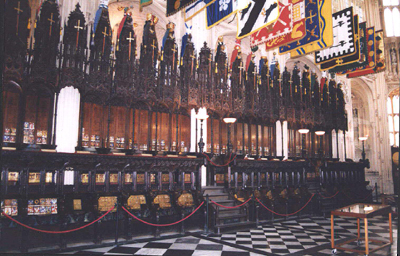

Ian G Brennan’s carved and gilded Royal Crest and Sword for HRH Prince William St George’s Chapel in Windsor Castle and some of the almost sixty Knights crests Ian has produced for Henry V11’s Chapel in Westminster Abbey.
Traditionally the swords for the Knights of the Garter are carved from Scots pine, painted and gilded and then places beneath the Knights Helmet in St George’s Chapel Windsor, so when Ian was creating Prince Williams Royal Crest and Sword and as he was also carving the Victory sculpture at the same time he thought he would make part of Prince William’s sword from original Victory oak as Prince William being second in line to the British Throne; the future King of England and will one day also be the Head of the Senior Service; The Royal Navy.


As the Victory replica was carved ‘running before the wind’ these signal flags and pennants although moving about in the wind have to be carved for the most part shown moving about in the similar direction as the ship, which to me anyway looked a little odd at first as you might possibly expect the flags would be trailing behind despite the ships forward motion just like they would look on a modern ship at sea. It must have taken almost one hundred and fifty feet of thin strips of oak from between 1mm to 3 mm thick to make all ropes and rigging, all of which were first cut into thin strips and then each one had then to be rounded off down the entire length. Some of the ropes and rigging were also carved in very tight curves in such a way to give the impression as if the ropes were curled up or sagging under their own weight.
Although the Victory with all the carved ropes might appear fragile it is much stronger than it looks and although it was possible to carve some lengths of ropes a bit thinner Ian resisted the tempting as the model has to be practical for normal handling and cleaning purposes, if it weren’t going to be placed in a display cabinet. Although if you think about breaking a matchstick takes a little effort despite it being made from much softer pine wood, however just in case of potential damage from friends and foe alike over the years and decades to come, Ian has also supplied along with the sculpture, many feet of spare thinly carved ropes, some sails and gun barrels along with various pieces of old Victory oak to make possible running repairs to the ship if needs must, just like the Victory’s crew would have done to in Nelson’s time.

One of the pods of dolphins can be seen on the starboard side ridding the bow wave
Ian also wanted to capture what HMS Victory would have looked like pitching about in a choppy sea, in full sail in a desperate attempt to gain more speed to engage the enemy. The warship forward pitching motion evident as the bow slightly dips into the sea; a pod of playful carved dolphins can be seen riding the bow wave totally unaware of the impending battle ahead, a sight that can be still be seen today with modern ships as you approach that part of the world.
The lower gun deck gun ports having just been opened and the guns run out, the very moment that some of the sails were about to be trimmed for the impending action. The spritsail due to this forward pitching of the warship has been carved as if it would have been set in choppy seas, not fully unfurled, even the sprit topsail is shown to be dipping down slightly on the port side as if the tension in the corresponding ropes and block and tackle to that particular sail has slackened off slightly.

Once the actual carving of the Victory replica was completed a wooden base then had to be made to raise the Victory and the ‘carved sea’ off the ground, which would enable the old iron hook which once held the ships mess table to be retained in its original position underneath the oak beam. A mahogany base was initially produced show above; however, as this base was made out of a modern timber Ian felt it was just not in keeping with the centuries old timbers use to create the Victory sculpture, so this base was later removed and a more appropriate original timber sort.
Ian was then reminded that perhaps what remained of the small piece of an original centuries old turned HMS Victory *deadeye he was given which he made the small 32 pounder gun for a charity event might with a bit of modification be suitable for the base. Although half of this particular deadeye was missing and in a very sorry state when Ian was first given it and what remained was split right through in many places and despite the fact that a piece of the wood had already been removed years ago to carve the 32 pounder gun, there was fortunately just enough left over which could be used to make the base.
* HMS Victory’s original deadeyes which were used to restrain and to put tension on the Victory’s various standing rigging lines. Two hundred and sixteen deadeyes were needed to set up the standing rigging.


HMS Victory’s original deadeyes’ in position on the ship and the remaining section of one of the deadeyes used for the Victory sculpture’s base.
The centuries on board the Victory however had really taken their toll on the wooden deadeye as both the original 30 mm iron bolts that once held the two halves of the deadeye together when it was fixed in position within the rigging on HMS Victory, around 2/3rds of the iron bolts had rusted completely away over the centuries so that only 6 mm of relatively sound metal remained.
It is not until you see the mass of sail and ropes can you begin to understand how complex a fully rigged First Rate Warship like HMS Victory would have been at action stations in full sail, that you begin to realise why it took 850 men, including a distant relation of Ian’s, to adequately crew the Warship.
With all the carved rigging added the Victory the carving looks very fragile. This is far from the case however, as all the masts and spars are supported each side by carved oak ropes all of which then held under tension by the carved oak blocks and tackles. These ropes then support and fix everything firmly in position, just as HMS Victory would have been at sea, consequently nothing on the Victory sculpture moves out of place and it is deceptively very strong. The HMS Victory sculpture is approximately 47 inches long (120cm) x 32 " (82cm) high and has been carved for the most part from one large solid piece of English oak and weighs around 45 lbs (20 kilo’s.)


On and off for almost two decades, whenever he could somehow try and find the time, Ian had been carving this sculpture of HMS Victory and has spent almost 6,000 hours to complete it Ian explains "It was a rather slow process as the oak being so old and rock hard. You have to take your time and make sure you carve it right first time, original oak is irreplaceable so you cannot make a mistake and simply discard the piece of wood and go to the local timber yard and get some more.
"When I first thought about the possibility of carving the Victory replica the idea was to have it completed by the bi-centenary of the Battle of Trafalgar in 2005 and although I was regular working on average of 60 + hours a week carving the Victory alongside my commissions and often burning the midnight oil to complete it in time, however in August 2004 with only a year away from its expected completion the plans I had envisaged for the Victory sculpture unfortunately didn’t quite work out as I hoped. So with the perceived impetus to complete it by this date now gone I could no longer see any real point in spending the additional many hundreds of hours that was still required to finish it by this date, so the whole project was abandoned and this rather special bi-centenary came and went.
As I no longer had a reason to continue carving the replica, using the correct naval terminology the sculpture was placed into ‘ordinary’ or as us landlubbers might say it was mothballed. All the top of the masts and yardarms were once again removed from the replica and it ended up looking rather similar to HMS Victory does now in Portsmouth dockyard as it undergoes its most recent restoration program. The carving was then placed under a polythene dust sheet at the back of my studio where it remained untouched for a number of years. On the upside as I was no longer spending all those hours carving the Victory I was now able to concentrating on my sculpture commissions and as a consequence as the dockyard were promoting a ‘saving the Victory fund’ at the time, I was now able to support the Victory in possibly a much more tangible way instead by making a financial donation to their worthy cause.
Although the Victory model was out of sight under the polythene sheet it was certainly not out of mind as the realities I was not getting any younger began to concentrate the mind somewhat and although I no longer had any plans for the Victory sculpture I didn’t really want to waste the 4,500 hours or so I had already spent carving it. So I decided I would have to start working on it once again alongside my commissions or accept the realisation it might actually never be finished.
Although I was now back working on it commissions which always had to take priority over carving the Victory, I initially spent a day here a fortnight there working on it and eventually the real enthusiasm I once had to complete the replica returned once again. However the prospect of having to continue working the very long hours required to enable me to complete both the Victory sculpture and my sculpture commissions for the foreseeable future was no longer a sensible option, especially as enquires for my sculpture commissions were still coming in all the time, which if accepted would now take well over a year to complete even without my working on the Victory. Obviously with having just one pair of hands, a difficult choice had to be made, Plan A or a Plan B.
Plan A was to turn down all future commissions apart from the five months or so of each year I spend on creating the various sculptures for the Royal Household and then not to eat for a year or so until the Victory was finished. Or Plan B to once again abandon carving the Victory and take on every sculpture commission I had been offered and get a life. In the end Plan A was adopted and despite the difficult economic times for what felt like an eternity survive we did, when with still a long way to go to complete the Victory, Plan A hit the fan. As a consequence, Plan B unfortunately now became the only real option and the Victory was once again being prepared to be placed into ordinary, perhaps this time permanently. Then out of the blue and in the nick of time, just like the cavalry of old in 2008 a Plan C suddenly materialised which was the vital support from John Callan an old family friend which no doubt saved this particular Victory from total oblivion, just like the Temeraire did during the Battle of Trafalgar with the somewhat larger version."

With the 250th anniversary of the original HMS Victory being launched now on the horizon, work on the Victory sculpture, once again began in earnest and then almost 6000 hours later the sculpture was finally completed on June 6th 2011. What remained of the original HMS Victory's old paint on the beam has all been retained within the sculpture along with the original handmade square nails and old copper screws and bolts, along with the green patina which has gradually built up over the centuries.
Although the oak would obviously look rather splendid after sealing and polishing like Ian usually does with his other wood sculptures, he tends to think perhaps this would be inappropriate for this particular sculpture and instead decided to leave it with its natural un-waxed old oak finish and texture, just as it has always been for many centuries hidden deep within the old oak beam on board HMS Victory’s lower gun deck.
The oak does not require any artificial finish to be added for preservation reasons anyway, as the oak it has lasted for many centuries in far worst conditions within the hull of HMS than the Victory sculpture is expected to have to endure in the future, without having any form of artificial finish being applied to the oak.
The natural untreated oak colour


The temporary ‘wash’ of white spirit having been added to the sculptures ‘sea’
As an experiment however just to see what the colour of the sculpture might look like if some form of artificial finish was applied; Ian put a ‘wash’ of clear white spirit to the carved sea the Victory is sailing in; immediately the wonderful rich medium oak colour of the oak stood out, before the white spirit quickly evaporated and the oak once again returned to its natural colour. Just applying the white spirit to the sea did however not only make the grain and the choppy sea stand out a little more but it also made it look as if the Victory was totally separate and actually sailing in the sea.
"Another rather compelling reason not to apply any finish to the model is if you ever have the opportunity to visit Nelson's Flagship HMS Victory in Portsmouth which I hearty recommend the first thing you will notice on entering the ship and walk on the gun decks is the strong smell of old oak, rope and tar which per mutates throughout the 18th century warship. Traces of this rather distinctive ships aroma could also often be found in my studio whilst I was carving the Victory oak, so I thought it would be a shame to seal in this century’s old history and aroma under a sort of modern-day wood sealant/finish making an unnatural barrier to this historic oak.
If past experiences are anything to go by the Victory oak shouldn’t require any artificial finish to be added for preservation reasons anyway as the oak has lasted for many centuries in far worst conditions within the hull of HMS Victory it is expected to have to endure in the future without having any form of artificial finish applied, so why change things now". Throughout the long hours the deadly battle raged, the exhausted gun crews anxieties and eventual exaltation as the battle won, was being absorbed into the very fibre of these pieces of English oak. This beam was indeed an integral part of the heart and structure of HMS Victory's great 'wooden walls'…. . If only walls could talk.
Towards the end of 2011 the HMS Victory sculpture was for the first time finally wrenched from Ian's grasp and away from the temptation of his incessant 'final' adjustments and driven by his son Scott around the streets of London past St Paul’s Cathedral were Admiral Lord Nelson’s lies at rest beneath the magnificent dome of St Paul’s. On through the City of London to the Carpenters Company which is a City of London Livery Company where it was placed on display in pride of place within the reception area of the magnificent hall for six months.


The reception area of Carpenters Hall in the City of London
After the Victory’s sculpture's return to Ian's studio from Carpenters Hall the temptation to make a one or many more than one adjustment to the carving resumed once again. Ian explained" Reworking the Victory sculpture yet again was something I had told myself and my family before the exhibition in the City of London would simply not happen, although quietly it was something I feared might. I know I am made of stronger stuff and will be able to resist such temptations easily. I mean I am strong willed, I gave up smoking thirty year ago the hard way without the patches, I found giving up smoking easy, I did it lots of times so I know it’s in me to stop making these adjustments to the Victory anytime I like. It was just finding the right moment, yes I decided I would definitely stop tweaking it that very day or if not the weekend which will be a good time, I just knew it, so on the 7th May 2012, exactly two hundred and forty seven years to the very day HMS Victory was launched at Chatham in Kent, work on the Victory sculpture was finally completed, yet again!
Although I have spent almost 6000 hours carving this Victory model, I do not class myself as model ship maker as this was only my first attempt at producing such a thing and will certainly be my last. Although I also appreciate that in the ship making world it is a model ship but not as we know it and I may well have gone off piste in the way I made this one, but I just didn’t want it to be made like so many other model ships superb as many of them are. I intended this one to be as much as possible simply hacked out from solid pieces of rock hard Victory ships timbers using carving chisels in the same practical simple style of carving as regularly practised by the ship carvers in the 18th century and if the odd rusty iron nail, possible pieces of shrapnel, fragments of rotten oak or dodging the various traces of long forgotten woodworm which once tireless bored into these magnificent old ships timbers just happen to get in the way of my constantly re-sharpened carving chisels, then sobeit".

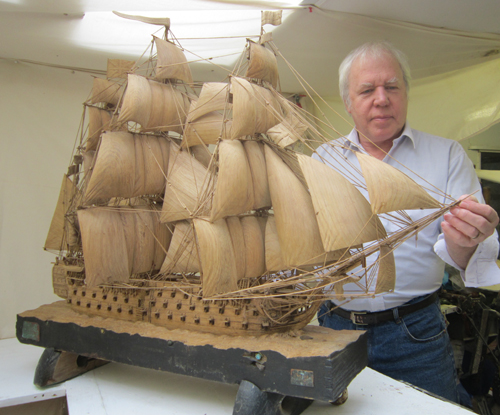
"When I first started carving Victory oak the wisdom and enthusiasm of trying to carve anything useful from these once discarded original ship timbers from Nelson’s famous Flagship and to preserve them all in a rather unique way very quickly began to diminish and the realisation perhaps there was properly very good reasons why not many things are created from Victory oak. Another rather cautionary tale if you needed one of how trying to make something from nothing can age you, when I first started carving this model of HMS Victory twenty years ago which was shortly after I completed the somewhat larger versions starboard side entrance port, I had a full head of dark hair."
Despite the challenge of trying to carve something from these old timbers as far as Ian was concerned was if it wasn’t for its glorious past it would have had an inglorious future and would have remained hidden within the old oak beams that were once initially thrown into a skip. Whilst we are on the subject of from whence it came; in March 2013 this Victory model having been carved by a ‘Man of Kent’ was placed on display in the museum’s new 'Hearts of oak' gallery in the historic dockyard at Chatham in Kent where HMS Victory was originally built exactly two and a half centuries earlier, by other ‘Men of Kent’.
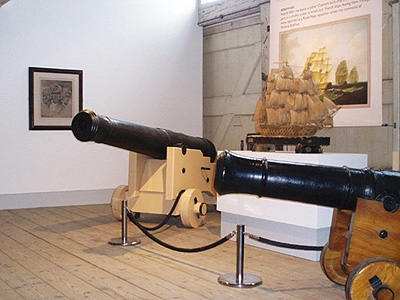
.jpg)
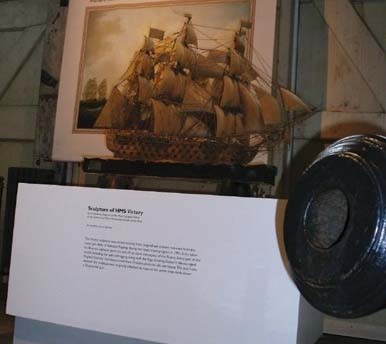
Click to enlarge
Whilst the model was on exhibition at Chatham Ian decided as a ‘swan song’ to protect it from the elements in the future he began working on a custom made sculpted mahogany and glass cabinet to display the model. So Ian, a former cabinet maker; decided for the first ship model he intends making would now be housed in the last cabinet he intends making. He also thought as the way the Victory sculpture was carved is rather unique so must the cabinet it was going to be housed in. So he incorporate some of the design features which he originally carved from mahogany into HMS Victory’s starboard side entrance port twenty five years earlier around the edge of the door of the mahogany display cabinet and as Ian originally intended all those years ago for it to be display in the museum as a small part of Royal Naval history, so Ian has now incorporated a small pieces of the Victory oak, iron and copper bolts which had been removed from the oak beams during the models carving process, has now been set into the frame work of the mahogany cabinet to enable visitors to also be able to also actually touch a small piece of Royal Naval history. At the front of the cabinet is also placed a small 5 inches high replica of Lord Nelson ‘life mask’ cast in bronze. He feels Nelson and the Victory were once together in the full size versions so they should also appear together in the somewhat smaller version.
The challenge of trying to convert this old pile of split, rotten, worm damaged ships timbers into anything worthwhile let alone a replica of HMS Victory although initially started as a labour of love there were many times over the years when Ian had neglected other things along the way to work on it, including having to turn down many potentially well paid commissions, it often appeared to be a 'boat too far. Fortunately however all the time and effort to carve it has since it would appear to have been worth it especially when it was initially expected to be placed on exhibition in the ‘Heart of oak’ gallery at Chatham Historic dockyard for a six months period, was eventually placed on display for over two years and towards the end of this period, also on display in the dockyard were historic exhibits on loan from such establishments as the National Maritime Museum in London; The National Museum of the Royal Navy in Portsmouth and an exhibit from the Royal Collection.
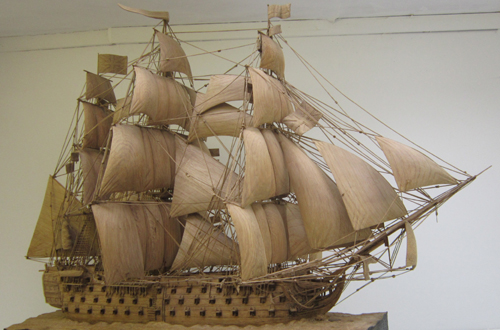
In May 2015 the gallery where the Victory sculpture had been on display was due to be closed as major long term refurbishment so Ian collected the Victory model and returned it back to his studio to be placed inside its newly completed sculpted mahogany cabinet he had built whilst the model was on exhibition and being aware it will be now rather difficult to find another available venue quite as appropriate to display the Victory replica than Chatham Historic Dockyard, Ian’s scale replica of Nelson’s Flagship depicted in full sail was subsequently placed in its bespoke carved mahogany cabinet Ian completed a few years later, placed between two large foam blocks to help protect it during transportation.
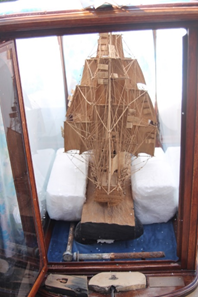
The Victory replica in its cabinet now appears as it has been wedged fast between ice flows as did Sir Ernest Shackleton ship Endurance in 1915 and the Victory Sculpture .
'Sailing to Victory'
by
Ian G Brennan

Artist Information HMS Victory Sculpture Upcycled sculptures Wood/Bronze Sculptures HMS Victory
Journal / Bio Garter Knights Crests Bath Knights Crests Creating a Crest/Arms Short TV Films Home